Newest Papers
-
Shi, Luzi and Megan Denver. 2025. The Transferal of Criminal Record Stigma in the Employment Context: Evidence from Conjoint and Vignette Experiments. Criminology. 63(1): 89-121.
-
Denver, Megan, Rod Brunson, & Oscar Navarro. (2026). “It’s a start”: Formerly incarcerated adults’ perceptions of second-chance employers and policies. EarlyView in Criminology & Public Policy
-
For the full paper, you can click here or email me (m.denver@northeastern.edu).
-
- Denver, Megan, Oscar Navarro, and Rod K. Brunson. (OnlineFirst). Bounded engagement and institutional interdependency: Exploring formerly incarcerated adults’ (non)engagement experiences and perceptions. Journal of Research in Crime and Delinquency.
The Other Writing and Research/Policy Briefs page also has summary research briefs for these papers.
==================================================================
Criminal Background Checks
Since grad school I’ve been really interested in criminal background check decisions for employment purposes, and this study with Garima Siwach and Shawn Bushway shaped my research trajectory in a lot of ways.
The decision maker in our study context — a set of attorneys in the New York State Department of Health (DOH) charged with making criminal background check decisions for healthcare and other licensed facilities across the state — also used an interesting “10 years since last conviction” decision guideline that I was able to examine here. The results from this study informed practice; the DOH reduced the time frame after seeing the findings.
Stigma Mitigation Strategies: Language and Positive Credentials
Most of my recent research has focused on criminal record stigma and positive credentials as a potential policy option to improve hiring outcomes.
This involves studies on labeling theory; here’s a more recent study I’ve worked on and one of my favorite past studies testing language and labels. I discussed the latter (2017) study on the National Institute of Justice’s 2023 conference plenary panel, “Inclusive Research: How Engaging People Closest to the Issue Makes for Better Science and Greater Impact” (see below). Both papers are also featured in Episode 104 of the Criminology Academy Podcast.
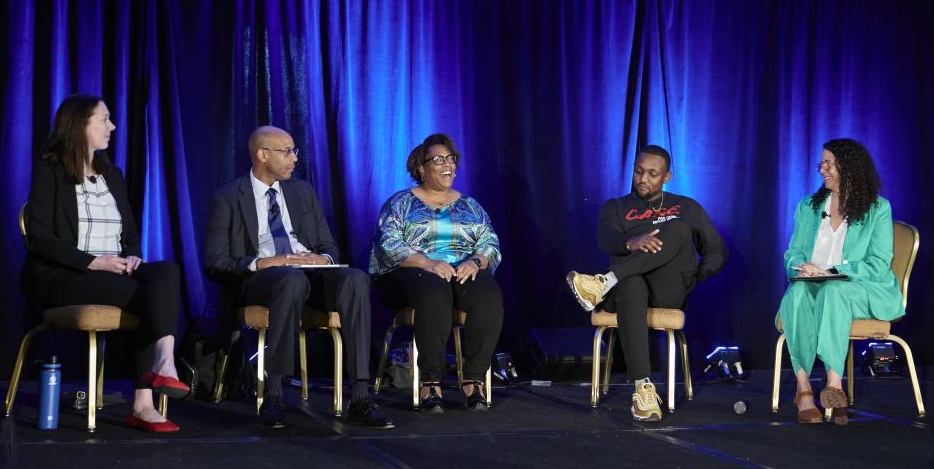
This area of research also includes experimental survey studies and qualitative content analyses examining whether and how positive credentials mitigate stigma in the hiring and licensing process.
Some of the key findings:
- Credentials can reduce criminal record stigma, with letters of recommendation serving as a particularly meaningful signal. The ability to transfer trustworthiness to employers seems to be especially important.
- Decision makers sometimes use evidence of rehabilitation and other contextual details to shape the narratives they craft.
- The use of evidence of rehabilitation can apply to a variety of contexts, including how law students with conviction records navigate good moral character assessments to become barred attorneys.
- Disqualifying conviction lists can exclude a large proportion of the population with criminal conviction records, but policy reforms could narrow these lists without increasing risks to public safety.
Happy to chat more or share any articles that are still stuck behind paywalls; feel free to email over (m.denver@northeastern.edu).
And a big thank you to Arnold Ventures for generously providing the funding to make four of the above articles publicly available through Open Access!
==================================================================
Here are some links to other papers:
Denver, Megan, and Samuel E. DeWitt. 2023. “[It’s] what you do after the mistake that counts”: Positive employment credentials, criminal record stigma, and potential pathways of mediation. Criminology. 61(1): 5-39.
DeWitt, Samuel E. and Megan Denver. 2020. Criminal Records, Positive Employment Credentials and Race. Journal of Research in Crime and Delinquency 57(3): 333-368. [Publicly available (open access) article]
Denver, Megan. 2020. Criminal Records, Positive Credentials and Recidivism: Incorporating Evidence of Rehabilitation into Criminal Background Check Decisions. Crime & Delinquency 66(2): 194–218.
Denver, Megan and Alec Ewald. 2018. Credentialing Decisions and Criminal Records: A Narrative Approach. Criminology 56(4): 715-749.
Denver, Megan. 2017. Evaluating the Impact of “Old” Criminal Conviction Decision Guidelines on Subsequent Employment and Arrest Outcomes. Journal of Research in Crime and Delinquency 54(3): 379–408. [Publicly available (open access) article]
Employment, Recidivism, and Criminal Background Check Policies
Denver, Megan and Brandon Behlendorf (equal authorship). 2022. Shifting Peaks and Cumulative Consequences: Disqualifying Convictions in High-Security Jobs. Journal of Research in Crime and Delinquency 59(3): 279-326. [Publicly available (open access) article]
Denver, Megan, Garima Siwach, and Shawn D. Bushway. 2017. A New Look at the Employment and Recidivism Relationship through the Lens of a Criminal Background Check. Criminology 55(1): 174-204. [Publicly available (open access) article]
Legal Consciousness and Criminal Records
Denver, Megan and James M. Binnall. 2024. The Lure of the Law for the Formerly Convicted: Pursuing the Legal Profession as a Resistance Strategy. Law & Social Inquiry. [Publicly available (open access) article]
Public Opinion Research
Denver, Megan and Justin T. Pickett. 2022. Race, Criminal Records, and Discrimination Against Job Seekers: Examining Attitudinal Mechanisms. Social Currents, 9(3), 226-244.
Drakulich, Kevin and Megan Denver. 2022. The Partisans and the Persuadables: Public Views of Black Lives Matter and the 2020 Protests. Perspectives on Politics, 20(4): 1191-1208. [Note: This is a publicly available (open access) article]
Lehmann, Peter S., Justin T. Pickett, and Megan Denver. 2020. Public Opinion on Criminal Records and Employment: A Test of Competing Theoretical Models. Crime & Delinquency 66(6-7): 995–1022.
Lageson, Sarah, Megan Denver and Justin T. Pickett. 2019. Privatizing Criminal Stigma: Experience, Intergroup Contact, and Public Views about Publicizing Arrest Records. Punishment & Society 21(3): 315-41.
Denver, Megan, Justin T. Pickett, and Shawn D. Bushway. 2018. Criminal Records and Employment: A Survey of Experiences and Attitudes in the United States. Justice Quarterly 35(4): 584-613.
 MEGAN DENVER